
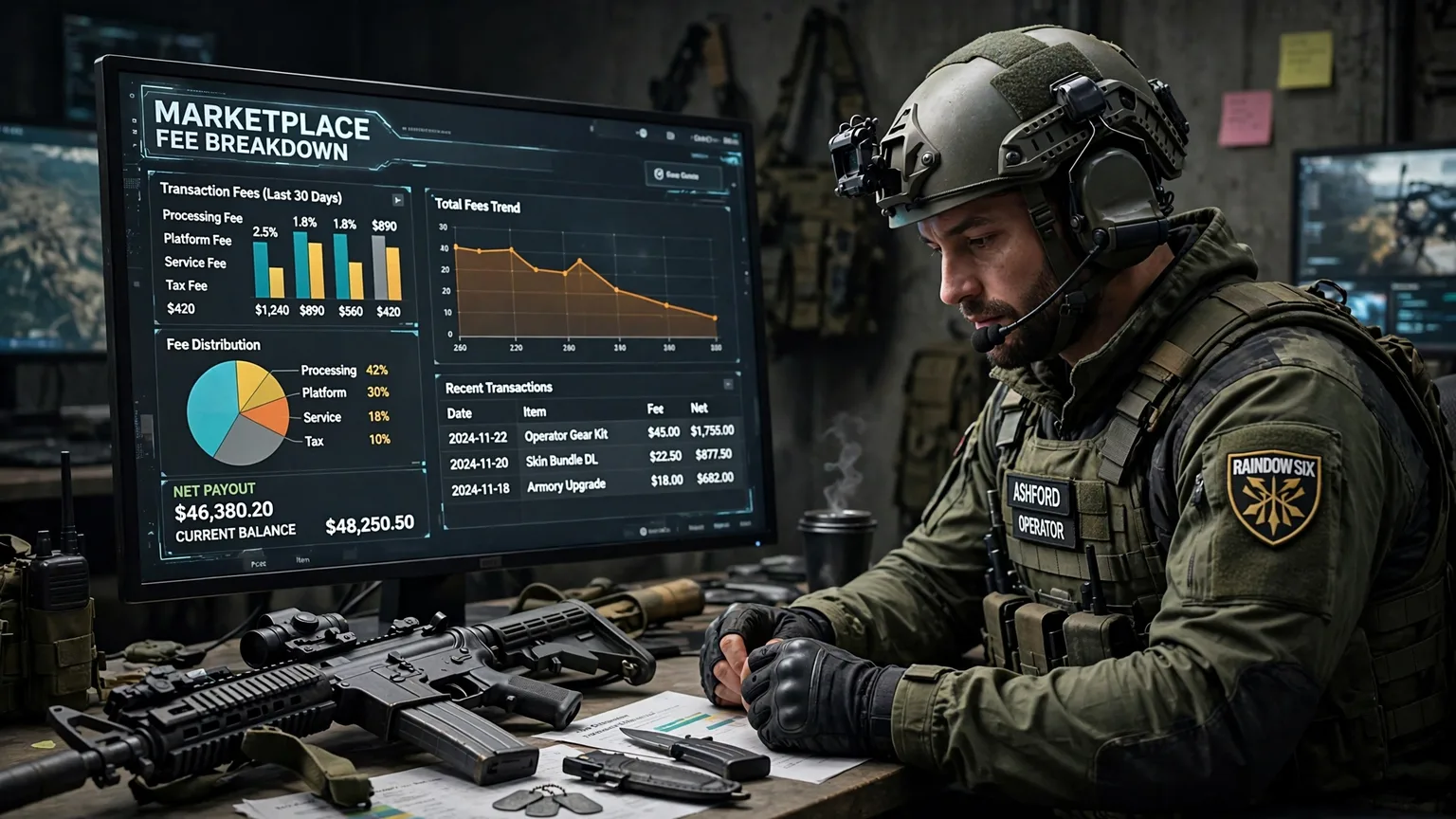
Every sale on the marketplace comes with a fee, and smart sellers plan for it before they list. This R6 Marketplace listing fees breakdown shows you exactly what you pay, why you pay it, and how to price around it.
What the Marketplace Fee Is
10 percent of the sale price
The marketplace fee is a charge taken from every completed sale on the R6 Marketplace. It is set at 10 percent of the sale price. When your item sells, the marketplace keeps 10 percent and sends you the remaining 90 percent. The fee is not added to the price the buyer pays. The buyer hands over the full listing price, and the marketplace takes its share from the seller's side of the deal.
The only fee on the marketplace
This is the only fee on the marketplace. There is:
- No charge for creating a listing
- No charge for cancelling a listing
- No monthly fee for using the marketplace
You only pay when an item actually sells. If your listing never sells, you pay nothing. This is good news for new sellers, because it means you can experiment with listings and learn how the market works without spending credits on fees.
The fee is automatic
The fee is automatic. You do not need to calculate it or pay it separately. The system deducts it during the sale and shows you the final payout. However, understanding the fee before you list is still important, because it changes how much profit you actually make. A seller who ignores the fee will overestimate every sale and may set prices that lose credits after the fee is taken out.
The 10 Percent Fee Explained
The 10 percent fee is simple to calculate, but it is worth working through carefully. Take your listing price and multiply it by 0.1 to find the fee. Then subtract the fee from the listing price to find your payout. An item listed at 100 credits has a fee of 10 credits and a payout of 90 credits. An item listed at 1,000 credits has a fee of 100 credits and a payout of 900 credits.
The table below shows the fee and payout at several common price levels. These are approximate examples to help you understand the maths, not live market prices. Real prices change daily, so always check the live marketplace before you list.
| Listing price | Fee at 10 percent | Your payout |
|---|---|---|
| 50 R6 Credits | 5 credits | 45 credits |
| 100 R6 Credits | 10 credits | 90 credits |
| 250 R6 Credits | 25 credits | 225 credits |
| 500 R6 Credits | 50 credits | 450 credits |
| 1,000 R6 Credits | 100 credits | 900 credits |
| 2,500 R6 Credits | 250 credits | 2,250 credits |
| 5,000 R6 Credits | 500 credits | 4,500 credits |
How the fee grows with the price
Notice how the fee grows with the price. On a cheap item, the fee is only a few credits and barely matters. On an expensive item, the fee can be hundreds of credits. This is why pricing mistakes are more costly on valuable skins. A 10 percent error on a cheap skin costs almost nothing, while the same error on a grail skin can cost a large amount of credits. The higher the price, the more carefully you should check your numbers before you list.
Think of the fee as part of your costs
It also helps to think of the fee as part of your costs, just like the price you originally paid for the item. If you bought a skin for 400 credits and sell it for 500 credits, your profit is not 100 credits. After the 50 credit fee, your payout is 450 credits, so your real profit is 50 credits. Many beginners miss this and think they earned twice as much as they really did. Always work with the payout, not the listing price.
What the Fee Pays For
It pays for the marketplace itself
The fee might feel like money lost, but it pays for the marketplace itself. Running a trading system for millions of players costs money. The servers, the security systems, the support team, and the constant monitoring all need funding. The 10 percent fee is how Ubisoft pays for those costs while keeping the marketplace free to browse and free to list on.
It pays for safety
The biggest thing the fee pays for is safety. The marketplace checks every trade, moves items and credits automatically, and keeps a record of every transaction. It also funds the security systems that detect fraud and protect accounts. Without this infrastructure, players would have to trade directly with strangers, which is far riskier. The fee is the price of a safe, working market, and most players find it worth paying.
It pays for convenience
The fee also pays for the convenience of the system. You can list an item in seconds, and it can sell while you are not even playing. You do not need to find a buyer yourself, negotiate in chats, or worry about whether the other person will keep their word. The marketplace does all of that work for you. Compared with the time and risk of arranging trades manually, a 10 percent fee is a reasonable cost for most sellers.
Cheaper fees elsewhere are not the same deal
Some players compare the fee with third party sites that claim to charge less. It is true that some outside sites advertise lower fees, but they cannot offer the same safety. They sit outside Ubisoft's system, so they cannot guarantee delivery or protect your account. They may also break the game rules, which can put your account at risk. A lower fee is not a good deal if it comes with a chance of losing your credits or your account.
How the Fee Affects Sellers at Different Prices
Low priced items
The fee affects every seller, but it does not affect every sale in the same way. On low priced items, the fee is small in absolute terms, but it can still matter. If you list a cheap skin for 50 credits, your payout is 45 credits. That is only 5 credits of fee, but it is still 10 percent of your earnings. If you sell many cheap items, those small fees add up over time. It is worth tracking them, even when each one feels tiny.
Mid priced items
On mid priced items, the fee becomes more noticeable. A skin listed at 500 credits pays out 450 credits. The 50 credit fee is enough to buy another small item, so it is worth thinking about before you set your price. Many mid range sellers find that the fee is the difference between a good sale and an average one. Pricing a little higher to cover the fee is a common strategy, as long as the higher price still attracts buyers.
High priced items
On high priced items, the fee is the most important number in the whole sale. A grail skin listed at 5,000 credits carries a 500 credit fee. That is a large amount of credits to give up, and it means your pricing needs to be precise. A small pricing error at this level can cost hundreds of credits. High value sellers should always check the current market carefully, compare several recent listings, and think about whether the payout justifies the sale. Our guide on Most Expensive R6 Skins shows which skins sit at the top of the market and why their prices behave differently.
Deciding whether to sell at all
The fee also affects your decision about whether to sell at all. If the payout after the fee is barely higher than what the item is worth to you, keeping it might be the better choice. There is no rule that says every item must be sold. Sometimes the smartest trade is no trade at all.
How the Fee Affects Buyers
Sellers build the fee into their prices
Buyers do not pay the fee directly, but it still affects them. The fee is taken from the seller's payout, which means sellers build it into their prices. A seller who paid 400 credits for a skin and wants to earn that back will list it for more than 400 credits, because the fee takes 10 percent of the sale price. The buyer ends up paying a price that includes the cost of the fee, even though the fee itself is charged to the seller.
This is normal in any market
This is normal in any market. Sellers pass their costs on to buyers through prices, and the marketplace fee is one of those costs. As a buyer, you do not need to calculate the fee, but it helps to understand why prices are set where they are. When you see a skin priced above what its previous owner paid, the fee is often part of the reason. The seller is not necessarily being greedy. They are covering their costs.
Set a realistic buy offer
The fee also affects the gap between buy and sell prices. The lowest price a seller is willing to accept is usually higher than the highest price a buyer is willing to offer, and the fee sits in the middle of that gap. Understanding this helps you set realistic buy orders. If you offer a price that leaves the seller with almost nothing after the fee, your order is unlikely to be filled. A fair offer leaves room for the fee and still gives the seller a reasonable payout.
For buyers, the practical lesson is simple. Do not expect sellers to accept prices that ignore the fee. If you want a deal, offer a price that works for both sides. The marketplace works best when buyers and sellers both understand the costs involved.
Fee Mistakes That Cost Sellers Money
Forgetting the fee exists
The most expensive fee mistake is forgetting the fee exists. Some sellers set a price, sell the item, and then feel cheated when the payout is smaller than expected. The marketplace did nothing wrong. The seller simply did not calculate the payout before listing. Always multiply your planned price by 0.9 before you list. That one step prevents the most common disappointment in marketplace trading.
Pricing to recover your full cost
Another mistake is pricing to recover your full cost without accounting for the fee. Suppose you bought a skin for 500 credits and want to get your credits back. If you list it at 500 credits, your payout is only 450 credits, so you lose 50 credits on the deal. To recover the full 500 credits, you would need to list it at around 556 credits, because 10 percent of 556 is about 56, leaving a payout of about 500. This is the kind of maths that separates experienced sellers from beginners. Work out the listing price that gives you the payout you want, rather than listing at the payout you want.
Listing very cheap items without thinking
A third mistake is listing very cheap items without thinking about whether the payout is worth it. If an item sells for 20 credits, your payout is 18 credits. That might be fine if you have many such items to sell, but it is hardly worth the effort for a single low value skin. Some sellers list everything they own, no matter how small the payout, and end up spending more time managing listings than the credits are worth. Be selective. Focus on items where the payout justifies the effort.
Trying to avoid the fee
Finally, some sellers make the mistake of trying to avoid the fee by trading outside the marketplace. This is against the rules and extremely risky. The fee exists to pay for a safe system. Trading outside that system removes your protection and can lead to scams or account punishment. The money you save on the fee is never worth the risk of losing your credits or your account.
Pricing Through the Fee
Start from the payout you want
Pricing through the fee means setting your listing price based on the payout you want, not the other way around. Start by deciding the minimum payout you would accept for the item. Then divide that number by 0.9 to find the listing price you need. If you want a payout of 450 credits, divide 450 by 0.9 to get a listing price of 500 credits. This simple formula is the most useful pricing tool a seller can learn.
Check the market before you apply the formula
You should also check the current market before you apply the formula. The price you need might be higher than what buyers are currently paying. If the market price is lower than the price you need, you have a choice to make. You can wait and hope the price rises, accept a lower payout, or keep the item. None of these choices is wrong. The mistake is listing at a price that ignores both the fee and the market.
Use the fee calculator to test prices
It helps to use the fee calculator on the site to test different prices quickly. Enter a listing price and see the payout after the fee. Try a few prices and see how the payout changes. This gives you a feel for how the fee scales, and it helps you find a price that balances profit and speed. Our guide on How to Price Items on R6 Marketplace explains pricing in more depth, including how to read the order book and time your listings.
Remember that the fee is the same for every seller, so it does not put you at a disadvantage compared with other sellers. Everyone pays the same 10 percent. Your advantage comes from pricing smarter, choosing better items, and timing your sales well. The fee is a fixed cost. Your skill as a seller is what turns it into profit.
Is There Any Way to Reduce the Fee
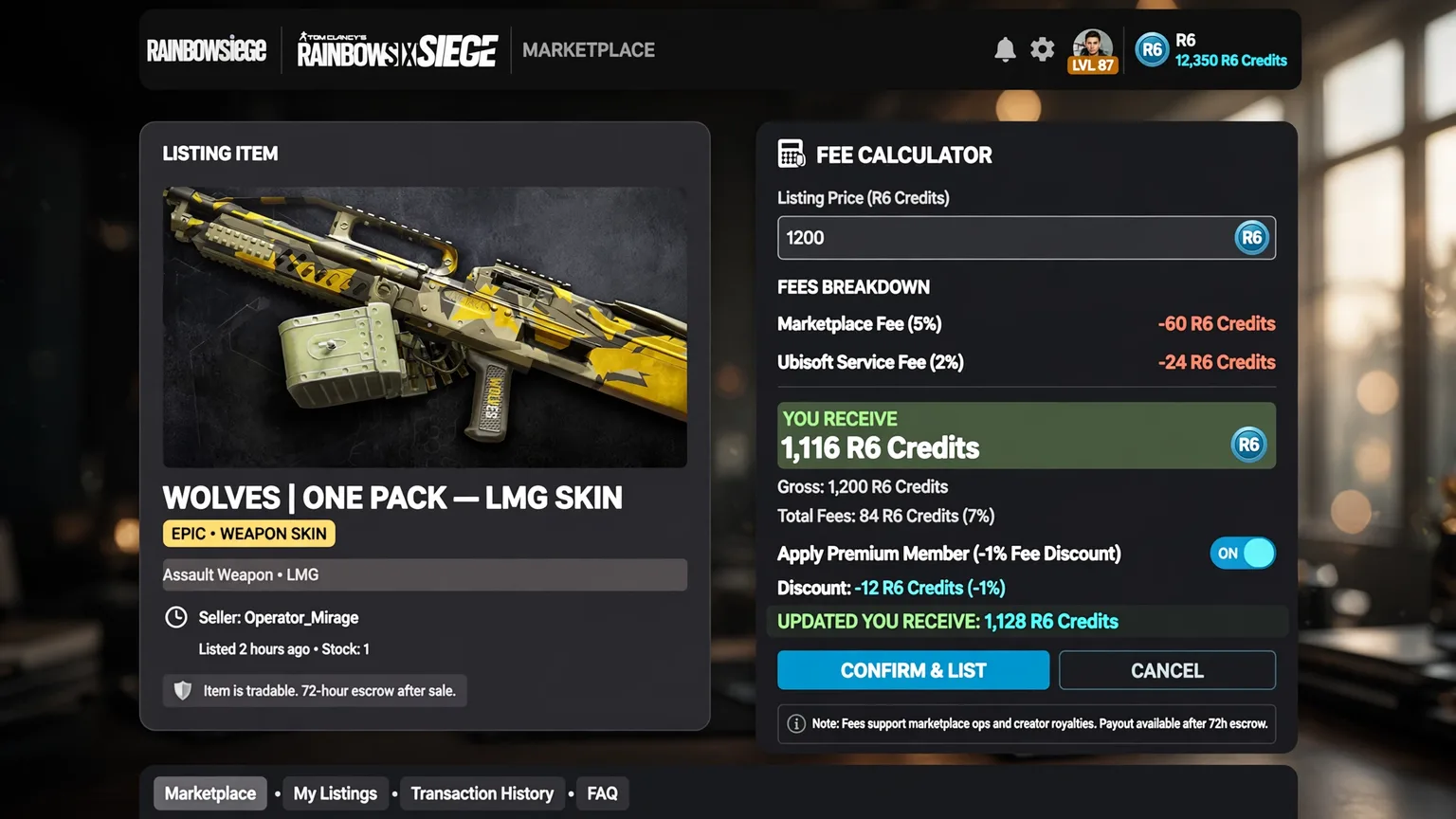
No official way to reduce the fee
There is no official way to reduce the marketplace fee. It is fixed at 10 percent for every sale, for every seller. There are no discounts for high volume sellers, no premium memberships that lower the fee, and no seasonal promotions that change it. Anyone who tells you they can reduce your fee is either mistaken or trying to scam you.
Beware of offers promising lower fees
Be especially careful of offers that promise lower fees in exchange for trading outside the marketplace. These offers are almost always scams. The person making the offer wants you to leave the protected system so they can take your credits or your item without consequences. The official marketplace fee is the cost of safety, and there is no safe way around it.
Reduce the impact by trading smarter
The only real way to reduce the impact of the fee is to trade smarter. Sell items where the fee is a small part of the profit. Avoid selling very cheap items where the fee eats most of the value. Price carefully so that the payout covers your costs. These strategies do not change the fee itself, but they make it matter less. A skilled seller treats the fee as a known cost and builds it into every decision, rather than fighting against it.
Frequently Asked Questions
How much is the R6 Marketplace fee?
The fee is 10 percent of the sale price on every completed sale. There is no fee for creating or cancelling a listing. You only pay when an item sells. Your payout is 90 percent of the listing price.
Who pays the marketplace fee, the buyer or the seller?
The fee is taken from the seller's payout. The buyer pays the listing price, and the marketplace deducts 10 percent from that amount before sending the rest to the seller. Buyers are still affected indirectly, because sellers build the fee into their prices.
How do I calculate my payout after the fee?
Multiply your listing price by 0.9. A 200-credit listing leaves 180 credits in your pocket after the fee. To find the listing price you need for a target payout, divide the target payout by 0.9. A target payout of 450 credits needs a listing price of 500 credits.
Can I avoid the marketplace fee?
No, there is no official way to avoid or reduce the fee. It is fixed at 10 percent for all sellers. Offers to trade outside the marketplace to dodge the fee are against the rules and are almost always scams. Stay inside the official marketplace.
Does the fee apply to cheap items too?
Yes, the fee applies to every sale at every price. On a 50 credit sale, the fee is 5 credits and the payout is 45 credits. On very cheap items, the fee can make the payout too small to be worth the effort, so choose your listings carefully.
Conclusion
The R6 Marketplace listing fees breakdown is simple once you know the numbers. Every sale carries a 10 percent fee, taken from the seller's payout. There is no fee for listing or cancelling, and no way to reduce the fee. The smart move is to build the fee into your pricing from the start. Decide the payout you want, divide by 0.9 to find your listing price, and check the live market before you list.
Treat the fee as the cost of a safe and convenient marketplace. It pays for security, automatic delivery, and a record of every trade. Price through the fee, avoid the common mistakes, and never trade outside the official system to dodge it. Build the fee into every price you set, and check the live order book on the official Ubisoft marketplace before each sale. That habit alone puts you ahead of most new sellers.